


Chat Over Lunch was conceived as a justification to ask people like Andy Hayler for lunch. I was thrilled that Andy accepted my invitation, as his website and restaurant critiques have been my definitive source of advice, both in the UK and beyond, for many years. We met at the Ritz restaurant. The reason for the choice will become obvious, and I provide my reflections on our meal throughout. You can find all of the usual restaurant details at the bottom.
UPDATE 18 Oct. 2025: Andy has written up his take on our lunch, which you can read here.
Andy Hayler is in his natural habitat. He is in the corner chair of the best table in one of the finest restaurants in the world. His domain lies before him, and he is its unquestioned master.
Indeed, Andy’s mastery was apparent even before we made it through the door.
Tipped by e-mail that Andy was going to be my guest, Ritz Head Chef Deepak Mallya met us at the entrance and led us to our table. It’s immediately clear that he and Andy are well known to each other and, indeed, that Andy is well known to virtually all of the Ritz team.
As we are seated, menus are wafted nearby, though I never quite look at one, and we chat with Chef Mallya, congratulating him on his recent formal promotion to the hotel’s Head Chef position. After a suitable chat, Mallya pays us the ultimate chef’s compliment, offering simply, “to cook something for us.” We are only too happy to agree.
On the surface, Andy’s relationship with the Ritz seems easy to understand: It’s his favourite restaurant, and he is a regular. But he is also one of the world’s most influential voices on restaurants and has written more than 50 reports on his meals at the Ritz since 2010. Over that time, his accounts trace the journey of the Ritz’s rejuvenation under Executive Chef John Williams.
In his first write-up in 2010, Andy found something unexpected: “This meal was a quite a revelation to me. It was many years since I had been to the Ritz, and although I had heard that in the last couple of years the cooking had moved up a gear, to be honest I was sceptical when I sat down. Yet tonight dish after fine dish appeared, with barely an error to speak of; I have had much worse meals than this with Michelin stars attached.”
The Ritz earned its first star seven years later in 2017, but Andy spotted the potential much earlier, observing in April 2013 that, “This was another very fine meal at the Ritz, clearly cooking at a strong one Michelin star level; at some point Michelin will hopefully acknowledge this.”
And by February 2018, Andy noted that it was operating on an even higher plane, especially when taking into account its comparatively reasonable prices. “This level of cost seems to me very fair given the high grade ingredients and technical skill present here. The cooking here just gets better and better, and this meal was firmly in two star territory.”
The second star did come for the Ritz, but only this year after another seven year wait. Far too long in Andy’s view. “As of 2025, The Ritz finally has the two Michelin stars that it has long deserved,” he wrote in March, “and is for me the best all-round restaurant in London.”
With all of that history, it becomes obvious during our meal that Andy isn’t just a regular customer or a critic. The Ritz team treats him as a trusted collaborator. They ask his views and really listen to his feedback. He’s valued for his expert palate and his ability to deliver clear, constructive feedback rooted in decades of eating at the highest levels of gastronomy in every corner of the world.
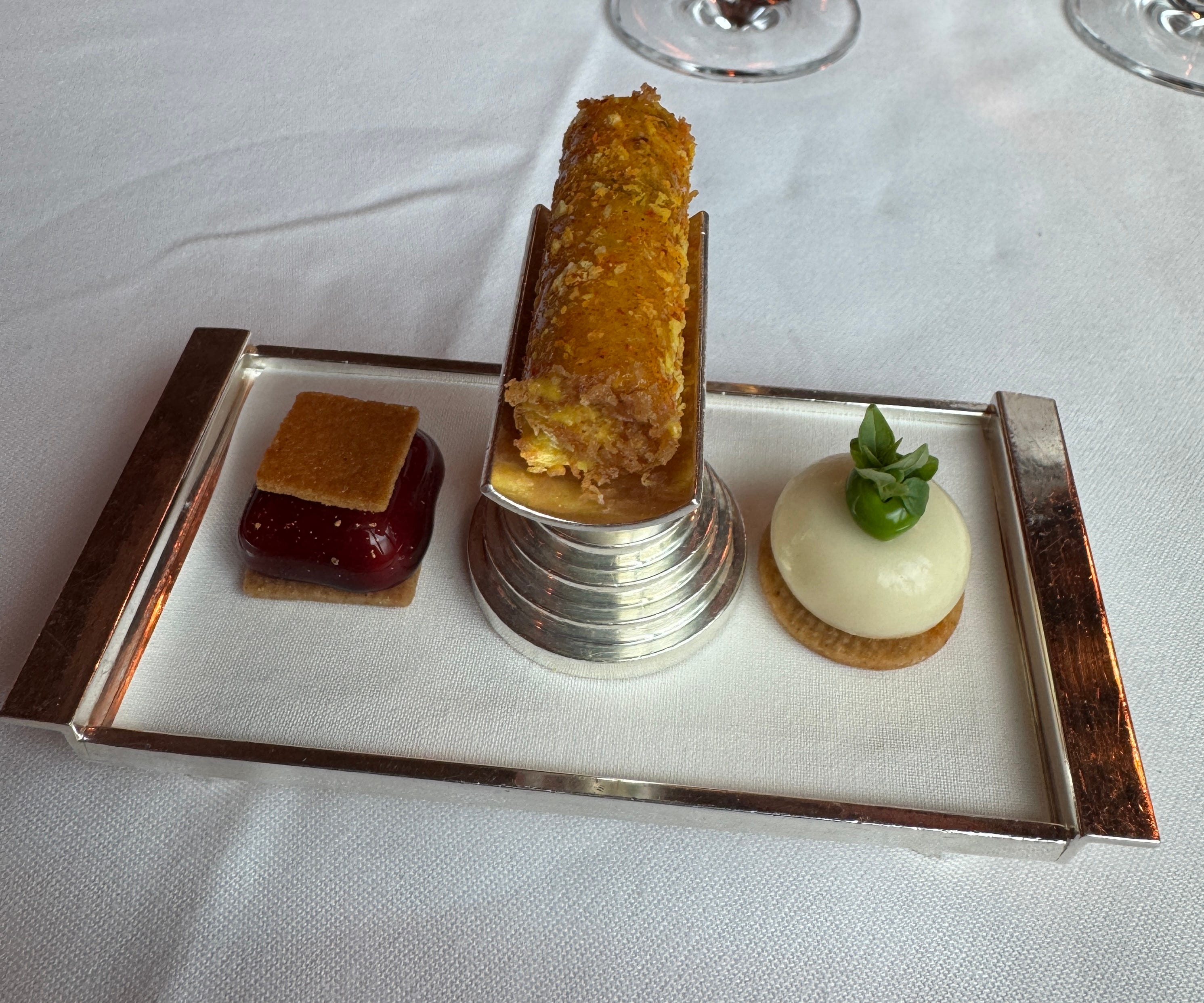
That’s even more obvious when snacks arrive. The centrepiece was a bite of coronation chicken wrapped in tuile. “It used to be a bit sweeter,” Andy told me. “But they have the balance just right.”
Andy’s journey to world-leading expert on fine dining started in the late 1980s by simply enjoying nice meals while travelling for work. Jobs with big energy companies kept him on the road a lot. He would occasionally submit reports, by mail, to the Good Food Guide, then the UK’s most important source of restaurant recommendations. By 1990, the editors had recruited him as an official inspector. “The deal was simple. I ate out as much as I could, wrote reports, and they paid,” Andy told me.
Around the same time, he started a simple newsletter for a few friends, and soon had a fortuitous encounter with foodie legend Clarissa Dickson Wright. This was a few years before she became TV-famous as one of the stars of Two Fat Ladies, and she was running the legendary Books for Cooks shop in Notting Hill. She suggested that Andy turn his newsletter into a book, and with backing from London Transport, he did so in 1995, creating a well-indexed guide of the best spots to eat across London.
Andy was also early on the Internet. His professional interest in technology led him to create his first website in 1996.
But a “Eureka!” moment that same year accelerated Andy’s journey. Jamin was one of the world’s top restaurants, created by Joël Robuchon at the height of his powers, and it was a huge force changing fine dining around the world. Hayler was entranced by his visit, and returned, he says, “Virtually every time I went to Paris over the next few years.”
Building on that experience, Hayler searched out as many top experiences as he could. And the Michelin Guide’s list of three-star places around the world felt like a good place to find the best of the best.
A few years later, he became the first person to eat in all of them.
Grand Master of the Culinary Chessboard
Excellence in chess requires a first-rate ability to remember and recall facts, strategies, and situations while under pressure in the game’s most critical moments.
And it turns out that, in addition to his affinity for the world’s best restaurants, Andy is an excellent chess player. He hastens to tell me that he is not in Master or Grand Master territory, but a quick check of the FIDE ratings database reveals that he is a “Strong” Class A player in the “Rapid” form of chess and was singled out by Grand Master Daniel King for playing the best game at a 2022 tournament in Hammersmith.
In addition to outstanding memory and recall, chess excellence demands the ability to consider situations with structure and rigour while also thinking laterally and creatively.
All of those traits come through very strongly in Hayler’s restaurant critiques.
And I have chosen that word carefully. Because under the Nunn definition, Andy doesn’t really write restaurant reviews.
They are more reports than reviews, and they follow a consistent format. He takes Michelin literally when it says that service and atmosphere form minimal part of the decision to award stars, so Andy rarely spends much time on experience. “Most of the newspaper critics want to be writers first,” he says. “I want to focus on the food.”
He tells me that the format of his write-ups has evolved over the years, but is fundamentally rooted in the inspection reports that he prepared for the Good Food Guide back in the ‘90s.
His website now includes reports from thousands of meals across hundreds of restaurants in every corner of the world, and it seems that he can recall the details of individual dishes from those meals almost on command. It is a gift that I don’t possess and truly covet.
In her book Cork Dork, journalist Bianca Bosker recounts her journey towards qualification as a sommelier, and she spends multiple chapters explaining the science of flavour. It turns out that understanding flavour and applying the right language to describe it can only be honed with extensive practice.
Andy’s voluminous experiences, phenomenal memory, superb palate, and ability to mentally organise and connect past experiences with the present moment all power his ability to give real-time reactions and insightful perspective on minute details.
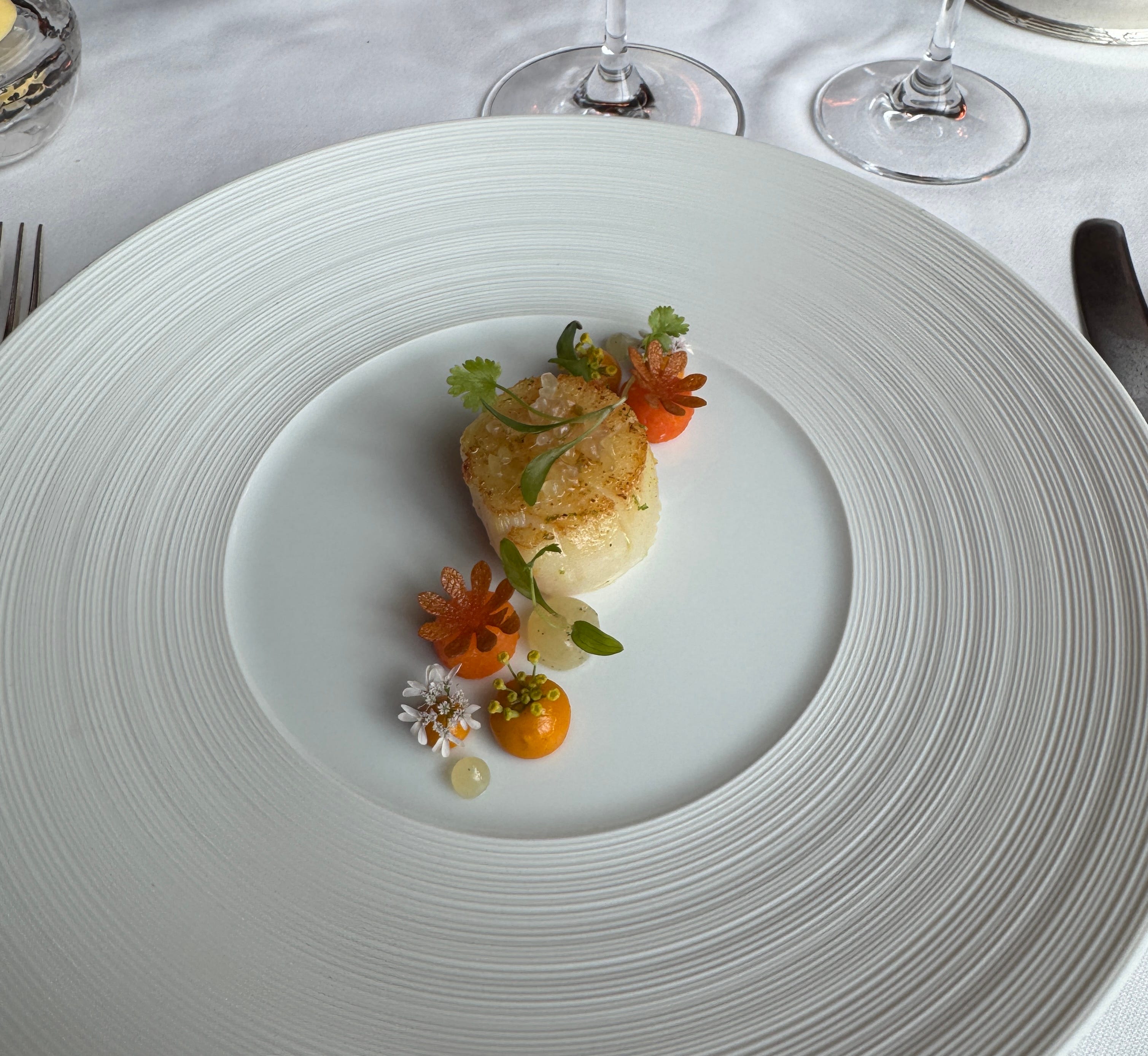
And that helps explain a fascinating moment partway through our lunch. It’s our third course — scallop — which Chef Mallya brings to the table personally. He explains that it’s a new dish, not yet on the menu. He hopes we will enjoy it. There’s a discussion about one of the ingredients. Later, he returns, and asks Andy specifically for his feedback and suggestions. Andy loves the dish. There is a further conversation about the ingredients. But it’s clear that the chef is listening. This is a genuine exchange of views, with real mutual respect. It isn’t simply a chef nodding along with the customer.
Ingredients & The Heart of the Fine Details
Andy’s incredible memory for flavour and minute attention to detail also help explain his obsession with ingredients. “Very few places can get the best ingredients,” he says. “Few even try, and many rely on the same suppliers.”
So when I ask him to name the best places in London, he points to the three that, in his view, have the strongest commitment to their ingredients.
“The Ritz, the Dysart [in Petersham], and the Cocochine [in Mayfair]. They are the best in London right now.” He goes on to explain how Cocochine, for example, has exclusive access to a farm and source for fish through its investors. I realise that I haven’t tried Cocochine as yet and make a booking while on the train home from the Ritz. I’ll report back in a few weeks.
The ingredient story at the Ritz comes to life most vividly when the langoustines appear. Brought down from Scotland each day, ours are presented to us on ice before they go into the pan. They are all still live. “There are only a very few places in the UK that still do langoustines at this level of freshness,” Andy tells me. “This is one of them.”


After leaving us, our langoustines are poached in butter and served with a beautiful salad of baby vegetables from Cornwall, a little fennel from Merseyside, and a cauliflower puree. The quality of the langoustine shines through on the plate, and the chefs haven’t done anything to get in their way. It is the most exciting, bright langoustine flavour that I have ever experienced. It has little in the way of adornments because it needs none. This is the kind of food that most excites Andy.
The Master of the Three-Star Experience
Andy says that he was never really on a quest to visit all of the three-star places. It sort of happened by accident. And then he mentioned to a friend in PR that he had nearly finished. A press release was sent around, and when the final meal was in the books, the story went everywhere.
It was 2008 and Michelin had recognised 68 three-star places. But their guides only covered Western Europe, a few U.S. cities, and Japan, which was added in 2007.
In the years that followed, Michelin expanded. Today, there are guides for more than 47 countries and territories. (Macau and Abu Dhabi have their own.) And, as of this writing, there are 157 restaurants holding 3 stars.
Michelin’s vigorous expansion has been driven by commercial deals with tourism authorities, who generally pay for Michelin to dispatch or recruit inspectors and create a guide.
In Andy’s view, that aggressive expansion has undermined the guide’s quality. “Hong Kong was a particularly bad example,” he told me. In his report on three-star Otto e Mezzo, he goes further. “Overall, this was pleasant Italian food, but the Michelin three star rating it gained in 2012 is, to be frank, laughable. In Italy, or even in London, cooking of this level would receive one star, and is another example of the truly bizarre ratings given by the Michelin Hong Kong inspectors. If an aspiring one or two star chef from Italy came here he or she would weep.”
Andy kept up with Michelin’s expansion for a while. In 2012, the FT covered his visit to his 109th three-star place. But as the Michelin growth — and dilution — gathered pace, Andy began to lose interest. “I was up to date for 16 years, but it just became impossible, and the quality was so different from one country to another.”
No one knows for sure how many inspectors Michelin actually employs. Andy believes there are about 10 or 12 for the whole of the UK, and that most countries with guides have a similar number. Historically, Andy understands that Michelin would send an inspector based in another market before a restaurant could receive two or three stars. He theorises that standard has fallen away thanks to expansion. “So few of the recent 3-star promotions are truly deserving in my opinion,” he says.
Sadly, that includes the UK. In addition to his three London favourites, he points to Row on 5 from Chef Spencer Metzger — funnily enough, formerly of the Ritz — as “better than any of the UK three-stars right now.”


Winelist Checkmate
Like me, Andy is a wine lover, which provides an additional reason to adore the Ritz: Their wine list is astonishing, and features choices across a broad range of price points. Andy should know. His restaurant reports often include an extensive analysis of the wine list, including a review of the mark-up on every single bottle and a calculation of the average for comparison with other places. Here’s his analysis from his visit to Row on 5:
The vast wine list had 1,566 different labels and ranged in price from £39 to £16,000, with a median price of £238 and an average markup to retail price of a hefty 3.5 times, high even by the demanding standards of central London. The list stretches over 227 pages and arrives in a vast, nicely bound book. Sample references were Domaine Gaujal Picpoul de Pinet 2023 at £56 for a bottle that you can find in the high street for £14, Mount Pleasant “Elizabeth Cellar” Hunter Valley Semillion 2016 at £69 compared to its retail price of £27, and Balgera Valgella Valtellina Superiore 2015 at £91 for a wine that will set you back £24 in the high street. For those with the means there was Marchesi Antinori “Tignanello” 2005 at £639 compared to its retail price of £234, and Château Beaucastel “Roussanne, Vieilles Vignes” Châteauneuf-du-Pape 2020 at £589 for a wine whose current market value is £164. The list covers the world of wine. Although 54% of the list is from France and 13% from Italy, there is coverage of wine producers from as far afield as Serbia, Ukraine, China, Japan and Turkey. There were just nine wines priced under £50 though 71 offerings under £75. By contrast there were 176 wines priced over £1,000, to give an indication of the primary target demographic. Some individual markups were very high, and I found six wines at more than ten times their retail price. On the positive side, I found 31 wines below their current market value, mostly at the pricy end of the list.
I asked Andy how he performs this analysis. Given his tech background, I imagined that he had created an AI to capture the list and run the figures. “Still by hand,” he told me. And there is weird reluctance in some quarters to help. “There was a restaurant in France that absolutely refused to give me a copy of the wine list. Or even take it upstairs so I could take pictures. One place even refused to let me look at the list until I sat down in the restaurant. They claimed it was unique intellectual property.” A data provider that holds lots of retail pricing information blocked Andy from automated access.
In spite of these obstacles, Andy has an enviable collection of data about wine pricing. From all of this analysis, Andy says that wine mark-ups have been on the rise over the last few years. But he doesn't fault restaurants for adapting to the changing and more pressured economic climate.
For our lunch, I selected a bottle of Block 6 Chardonnay from New Zealand producer Felton Road. The Ritz priced it at £165 per bottle, and you can find it on the high street for about £40. A not unreasonable 4:1 mark-up. We then moved on to a wonderful Savoy vineyard Pinot Noir from Radio-Coteau on the Sonoma Coast at a fantastic 2:1 mark-up. Finally, we gave into temptation for a 2020 Vin de Constance by Klein Constantia — a favourite for both of us. Very reasonable at £160, compared to about £80 on the high street.


Over dessert, we talked a little about the rise of influencers. “Congrats to them. I think it’s great that they can make a living from food,” Andy told me. Moreover, anything that gets people to go to restaurants and try new experiences is for the best. But on the national papers, “There’s been an erosion of quality. There’s a problem of money. There’s not enough to do the job very well.” We both despaired that Row on 5, certainly one of the best new restaurants in the UK in the past year, will likely never be reviewed in a major newspaper. “They just can’t afford it,” as Andy said.
After a wonderful afternoon in the Ritz, we were the last table, and crews were assembling to transform the space into a ballroom for the night. The Ritz team very gently moved us elsewhere to finish our wine.
I thoroughly enjoyed our afternoon. I won’t soon forget the chance to experience the Ritz as Andy does, and I’m grateful to both Andy and the Ritz team — especially Chef Mallya — for letting me participate and for making the afternoon so outstanding.
As we were wrapping up, I asked Andy where he was heading next. “Sri Lanka,” he told me. “I’ve never been.” And I was relieved and encouraged to hear that even for the Grand Master of fine dining, his appetite is never entirely satisfied.
Restaurant Details: Ritz Restaurant
Quick hit: One London’s best restaurants, with delightful, old-school service and impeccable food.
Details: Booking essential. St James.
Restaurant website. More on Instagram and from Michelin.
Read Andy’s most recent review and surf his archive of Ritz reports here.
Find it on Google Maps. Ritz Hotel, 150 Piccadilly, W1J 9BR.
Thanks for reading this edition of Chat Over Lunch. Please feel free to share with friends and colleagues, and subscribe if you haven’t already.
Andy is a walking almanac to dining, sipping and doing both very well.