

Weekly Review: Planque
Global influences, obsessive care, and inspired creativity offer diners the opportunity for discovery.

I visited Planque because Jonathan Nunn told me to.
Back in December, London’s most comprehensive and definitive voice on restaurants unveiled his list of the capital’s Top 99 best restaurants. Vittles founder Nunn worked on the list for two years, and it includes a seemingly impossible-to-actually-visit-them-all mix of places from every corner of town across an extraordinary range of culinary traditions.
Thanks to Substack e-mail length limits, the list was rolled out in chunks over the course of a week, with Nunn’s choice of the top place was released on its own on Friday, 12 December.
I was working from home that day, and sitting on a Teams call when the e-mail arrived. I opened it immediately and was mildly shocked to discover that the weeklong build-up had culminated with Planque.
In the recesses of my mind, I could find only this: “Wine focused. I think mostly natural wines. (Yuck.) Some pretty good French-inspired food in Shoreditch. Possibly too hip for me.”
I skimmed Nunn’s write-up, considered the prospect of a desperately boring January, and jumped online to book before all of the other Vittles readers did the same.
As a result, I found myself emerging from the Haggerston overground station a couple of weeks ago, hustling through a cold rain and across the street into the oasis that is Planque.
The vibe is deep scandi cool. And, indeed, it has to be one of the most gorgeous dining rooms that I’ve visited in a long time. There’s a long, communal table running the length of the restaurant. At the far end, the kitchen is tucked into a railway arch. At the near end, the other railway arch has a few polished tables and a small, comfortable bar area. Behind that, there’s a big, tempting wine room encased behind glass.
We were seated at one of the end the communal table, and I was a little worried about this, but the tempo of arrivals and departures was managed perfectly, and there were no awkward moments.
That’s said, there was an immediate middle-aged man in Shoreditch problem. I couldn’t read the menu. It was well-past-sunset dark in the restaurant, and I just couldn’t see it.
Fortunately, the communal table saved us. As I was reaching for my phone and its handy light, a couple down the line passed us the table’s little lamp and showed us how to turn up the brightness. Saved.
Our waitress was brilliant, funny, and engaging, and she steered us with a firm hand towards the right number of dishes and, sensing an opening of perhaps a micron’s width, recommended her favourites. She also helped us with wine, and we wound up with a delightful food-odor-free new world Chardonnay.
For our first round — snacks — we chose oysters with horseradish. I wasn’t sure about this, but it was excellent. The horseradish sauce was sensitively done, a great balance for the oysters’ natural sweetness without overwhelming them.
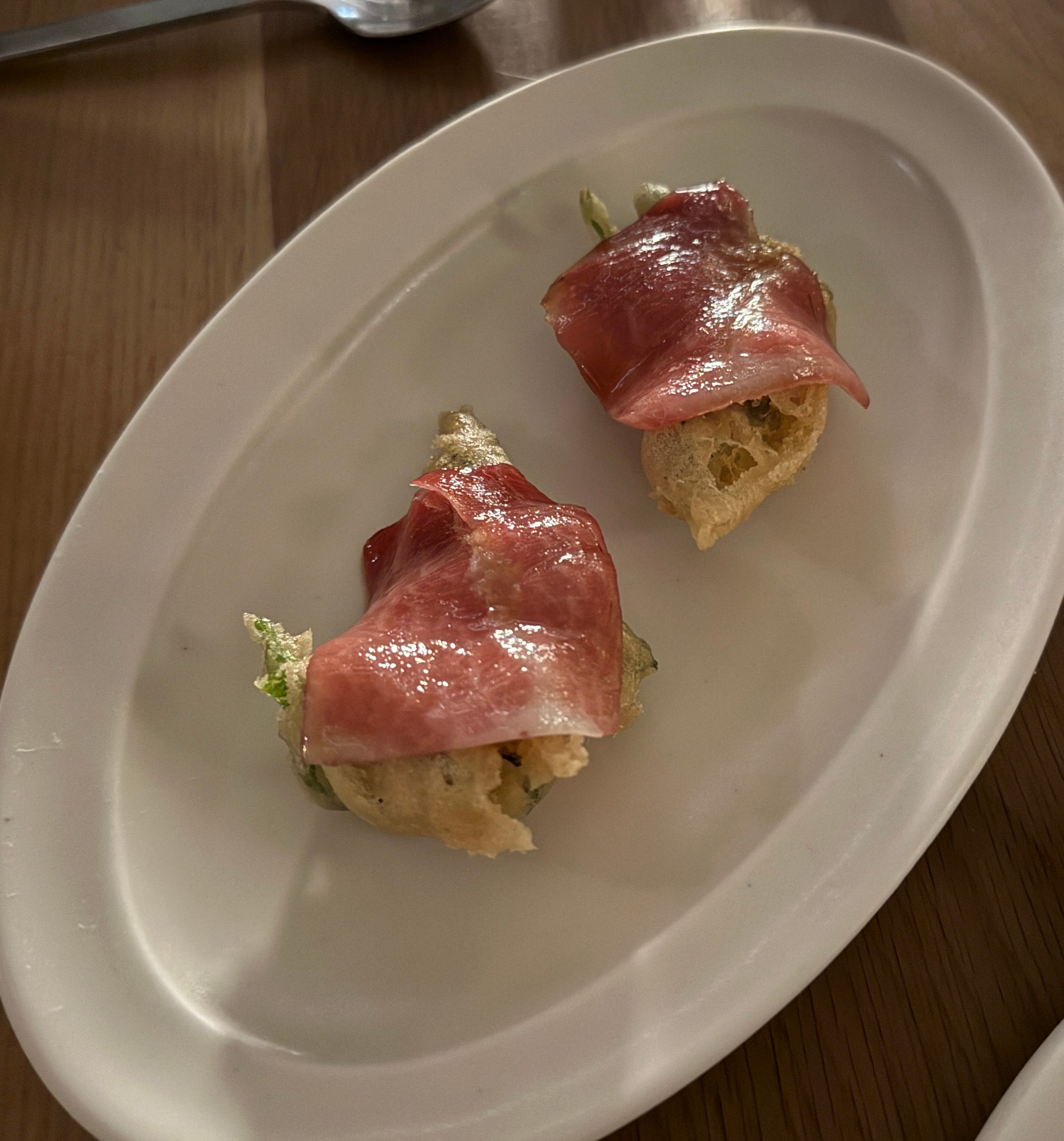
We also had “Cornish tuna belly & fried Alexanders.” This was a discovery, and, indeed, I had to look up what “fried Alexanders” actually are. Turns out they are from a wild edible plant. But the whole thing was an amusing take on sushi, and the tuna, with a little hit of pepper, was out of this world.
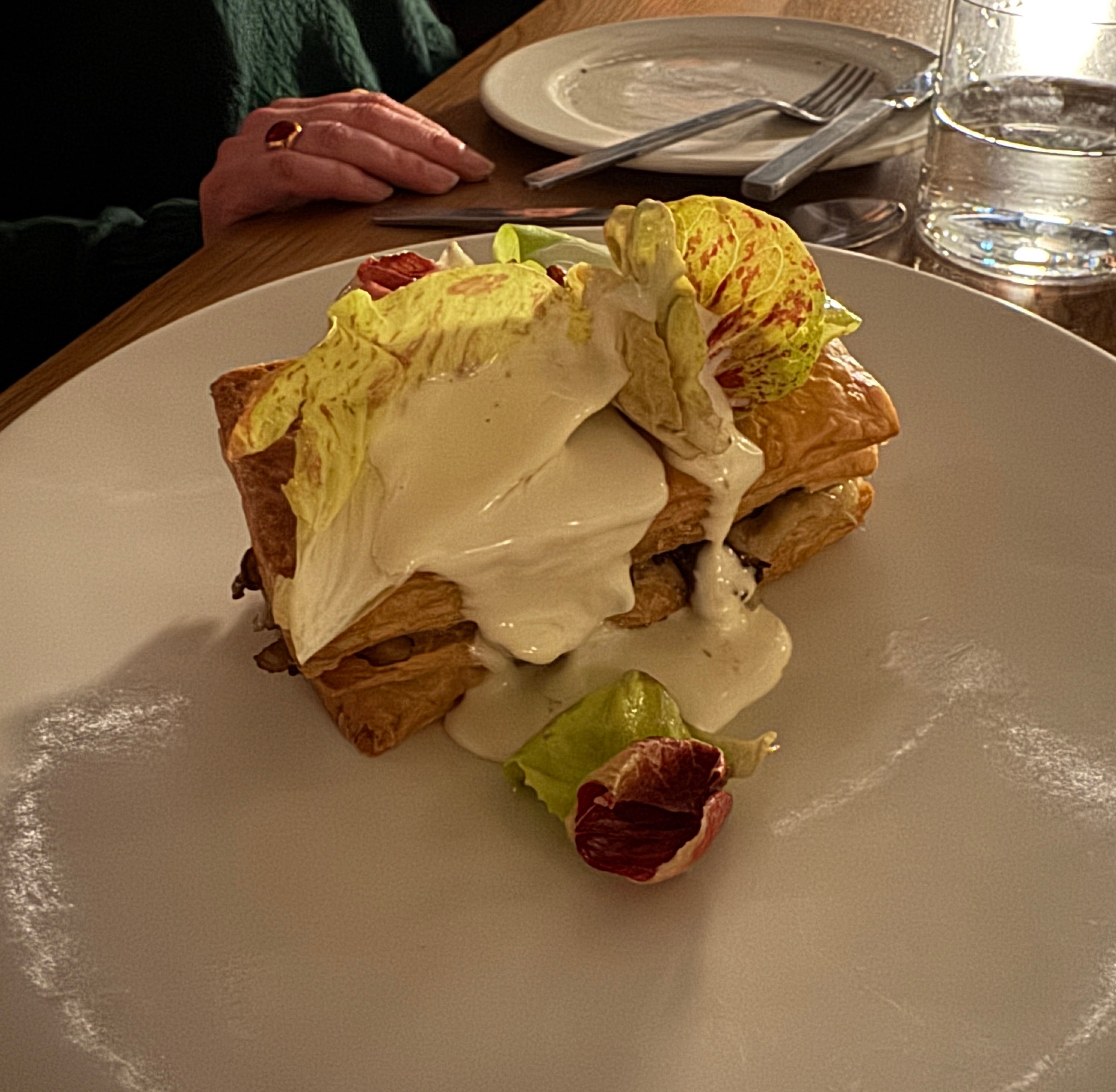
My favourite dish was the Hen of the Wood Mille Feuille with a sauce made from Beenleigh Blue cheese. This was rich and decadent, but not too much so. And the pastry was incredibly light, but still full of flavour. I’ve rarely enjoyed anything with such a stunning balance of sweet, salt, and umami that also has a perfect balance of texture. It’s a real breakthrough dish.
Next was “Cockle & Laverbread Rice.” And I need to confess two things: My first bite of this dish was weird. Because the bread was left crunchy, the mouth sensation was like eating the cockle’s shells. But by the third bite, I loved it. The textural game worked, and the flavour was superb. So my other confession: I don’t understand how it’s made. I also don’t care.
The first of our mains was John Dory with pistachio and puntarelle, a bitter, chicory-like vegetable common in Roman cooking. This was another discovery. The fish was perfectly cooked, of course, but the blend of flavours was something entirely new to me.
On the other hand, our mutton dish most definitely wasn’t. The sauce accompanying the mutton was made from “braised greens.” It tasted exactly like pot liquor, the remains of slow cooking big, course greens like collards or mustard greens for many hours. Where I grew up, pot liquor is served over cornbread, usually with white or pinto beans. Here, it was paired with chickpeas and the most tender, pink, meaty serving of mutton that I can imagine.
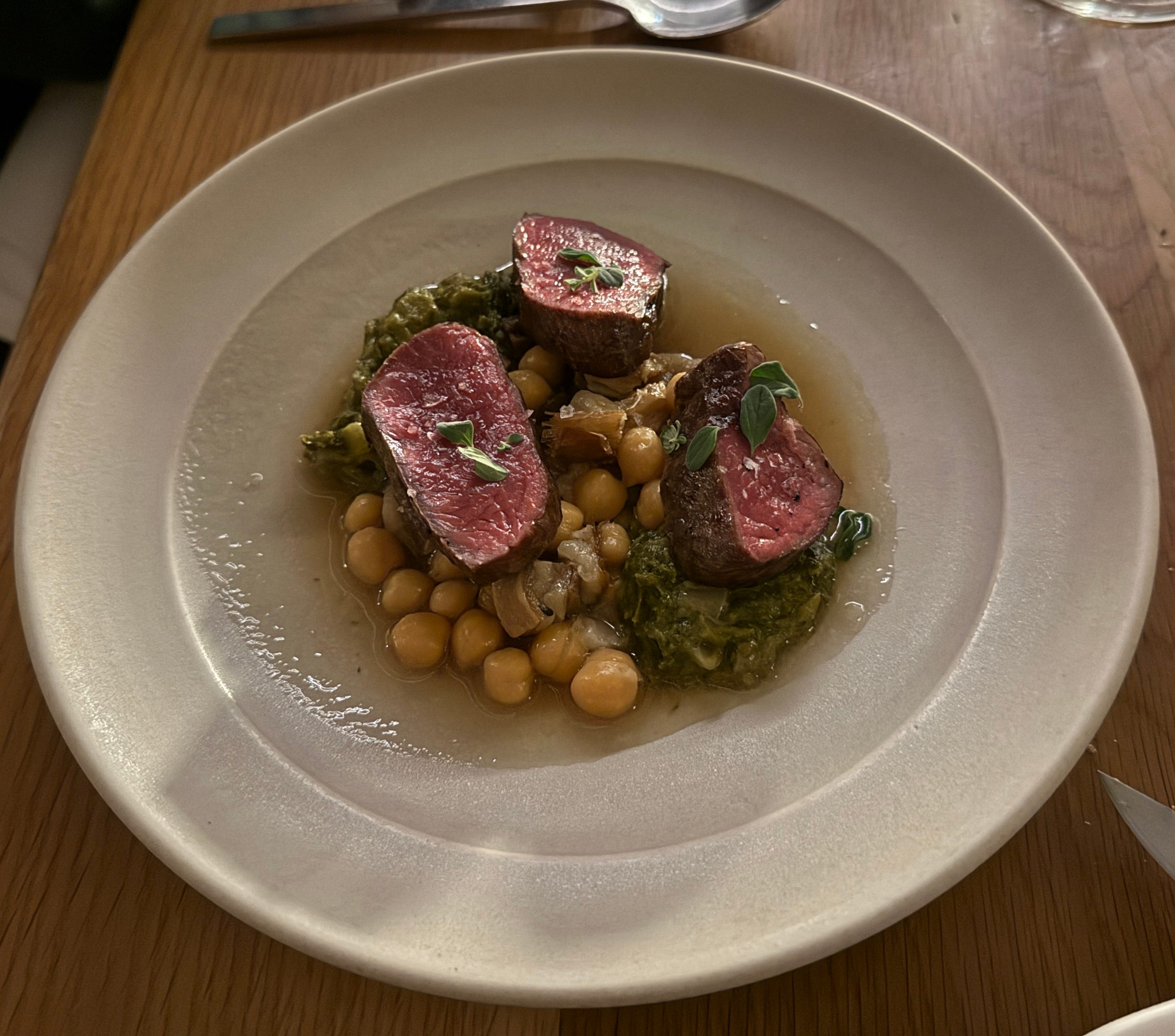
I suspect I’m transposing the culinary traditional that I know — from the American south — onto a similar tradition from elsewhere, and I’m sorry for not having that detail. But that doesn’t change the central point: This dish was traditional peasant food, deftly refined into something new.
As we considered dessert, our waitress reappeared to help. And now, with 90 minutes familiarity, she was even firmer with us, basically instructing us to order the Wigmore ice cream with meringue and the Pear choux bun. Needless to say, these were both excellent.
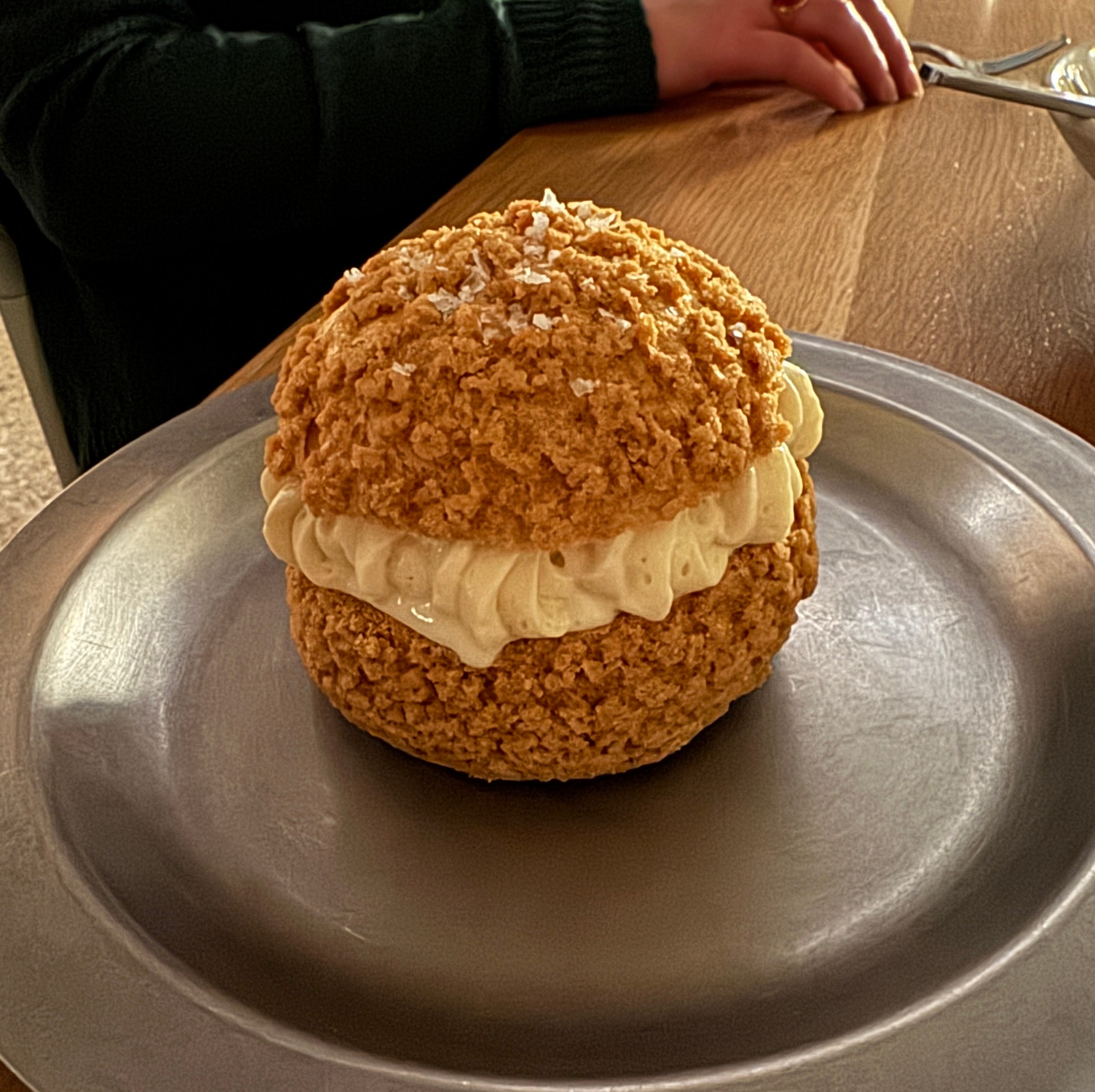
The ice cream was really rich. The cheese flavour comes through and acts as a balance for the meringue’s intense sugariness. Together, it was a sweet cheese course. Weird but wonderful. The choux bun was similarly great.
Reflecting a few days later, I can see why Nunn and a brigade of chefs love Planque so much. As he explains, it “discards all the trappings and concentrates solely on the food.” And there is a global vision in the cooking that is difficult to find in other places because it is so hard to master. There are notes of Paris, Copenhagen, Oslo, Melbourne, and Palermo in the recipes.
The genius behind Planque is Chef Seb Myers, who Killian Fox profiled for The Observer at length just the other day. Among many other things, Fox explores why Planque hasn’t attracted more conversation.
“Planque opened in September 2021, but acclaim has been a slow build… When I first approached Myers about this profile, in November last year, he lamented the lack of recognition. ‘We just turned four years old,’ he said, ‘and I’m not going to lie, there are times when we scratch our heads and go…’ He trailed off, reckoning with his bemusement. ‘I mean, we don’t really do any PR or anything like that, and I quite happily work away in the background, so a lot of these problems are of my own creation. But sometimes we do feel underappreciated. We are better known in Paris and New York than in our own city.’”
Nunn has a theory about that: “Michelin has not given Planque even a single honour – a reminder of the self-imposed incarceration these honours force restaurants into. I would prefer it stayed this way. Myers is often described as a ‘chef’s chef’, and I believe this is because he is cooking with a freedom that so many of his colleagues long to enjoy.”
Perhaps Planque’s time has finally arrived. Perhaps Michelin will sort themselves out next month, and award Planque the star that it clearly deserves.
But is Planque the best restaurant in London? It is not. Though the food was imaginative, free-spirited, and progressive, there are better places. Some with better food, some with better service, some with better atmosphere.
That said, who cares?
I love eating out and trying new places in part because, occasionally, I get to experience something new. In a normal meal at a great place, you might make one discovery across 8 or 9 courses. At Planque, I made 3 or 4 discoveries across 8 dishes.
So Planque is delivering discovery in a way that few places in London can manage at the moment, and it’s doing so in a couple of very well-appointed railway arches in Haggerston.
You should go. Love or hate it, if you enjoy finding something new in food, value creativity, or want to experience a progressive force in cooking, you really have to.
Quick hit: Global influences, obsessive care, inspired creativity offer the chance for discovery.
Details: Booking essential. Shoreditch. £££.
Restaurant website. More on Instagram and from Michelin.
Find it on Google Maps. 322-324 Acton Mews, E8 4EA.
Thanks for reading this week’s review. What’s the your favourite (not necessarily the best) restaurant in London? Tell me in the Comments. And please subscribe if you haven’t already.
That choux bun looks magnificent! The menu prices look really quite affordable, although the wine list looks quite punishing, but then they all do to me these days. I remember when Planque first opened, I got the impression it was basically for wine snobs and not somewhere that I would want to go, so all the recent coverage has put it in a new light for me. The only issues are the location, the communal table (I never want to eat at a communal table), and focus on natural/low-intervention wine. Everything, apart from the food, is screaming, 'We Are Not For You' at me. Michelin say that 'the modern British dishes are far more complex than they first appear and show tremendous skill from the kitchen', which has got potential Michelin star written all over it. Let's see what a week on Monday brings.