

Weekly Review: Yellow Bittern
Pure hospitality. Excellent food. More supper club than restaurant. And occasionally, a good deal more.

When it first opened nearly two years ago, the Yellow Bittern attracted all sorts of attention. Some of it for the wrong reasons. And the chef and owner, Hugh Corcoran, takes umbrage at the idea that his restaurant is controversial. (If you are interested in the backstory, Jonathan Nunn has the definitive take at Vittles.)
I have always said that the only fair way to assess a restaurant is on its own terms. To view it — and to judge it — as it aspires to be seen, understood, and experienced.
But the noise around Yellow Bittern made it difficult, in my view, to judge it fairly. So I decided to wait.
I planned to give it a year, but other commitments and priorities got in the way, and I didn’t manage to visit until last week. Chef Hugh’s new Substack served as a useful nudge.
So, if we are going to judge the Yellow Bittern on its own terms, what does it aspire to be? Chef Hugh wants it to be seen as simple and conventional. “We provide the typical service repeated all over the world of a table, at which you order food and wine, and then pay for it at the end,” he says.
I think he’s under selling that bit. Corcoran is Irish — from Belfast — and grew up in the 1990s, before the Good Friday Accords, when his home town could be particularly rough. He has strong political views, which he has described as Communist. His background and perspective have shaped his restaurant. He practices a wonderfully welcoming form of Irish hospitality that invites everyone in for food, drink, music, laughter, and an occasional argument. He hopes it is accessible for everyone, and his price point for a big, hearty lunch is a very reasonable £50.
Chef Hugh also loves wine, and has spent a good deal of time in France. He feels strongly that his food is better with wine — not exactly a revolutionary thought — and encourages his guests to experience the best that he can possibly find, sold at astonishingly reasonable mark-ups.
So far, so normal.
But arriving for a Friday lunch, there is something about the vibe that captures my attention. There’s a small, hand-written sign in Chef Hugh’s tiny, open kitchen discouraging guests from using mobile phones. There is an eye-catching mix of art filling the walls all the way to ceiling height in the French or Victorian manner. The tables are close together, and the whole thing feels more like a supper club in someone’s home than a restaurant on the Caledonian Road. It encourages informality. Invites you to relax and leave the world outside.
The vibe also reminds me of the old workers cafés in nearby Islington — there’s one on Upper Street and another on the Holloway Road. Before Starbucks and Cafe Nero, when local neighbourhoods were less transient, they were the “third spaces,” that later became a commercial contrivance. A place to do the crossword and enjoy a strong tea. To chat for hours with a friend or grab a bacon roll on your way to work. Everyone welcome. Prices cheap. Food basic but tasty. Coffee always available. They defined their local high street before our high streets surrendered to global chains.
Analogous, yes. But Corcoran’s version is better. The food is elevated and benefits from his Irish influences and French training. There are tablecloths rather than formica. And the wine selection is outstanding, and far more appealing than always-on coffee.
On the day we visited, there was a single seating for lunch at 1:00 p.m. As tables arrived, Corcoran came around to help everyone make a wine selection. For my friend and I, he guided us to a lovely bottle of Rully, which was wonderfully ripe and just the right balance of oak.
A few minutes later, lunch began to appear. There was a menu on a board somewhere, but I never saw it. Everything was served in courses to the whole restaurant all at once.
We started with homemade bread and butter — delightful Irish bread, the trend towards inedible sourdough studiously ignored.
The first course on a warm London day was a cold soup made from cucumbers, dill, yoghurt and buttermilk. The last ingredient was key — though Chef Hugh told us that it went in the soup as a leftover from dishes made earlier in the week. The acidity was the vital element, and the soup was superb.
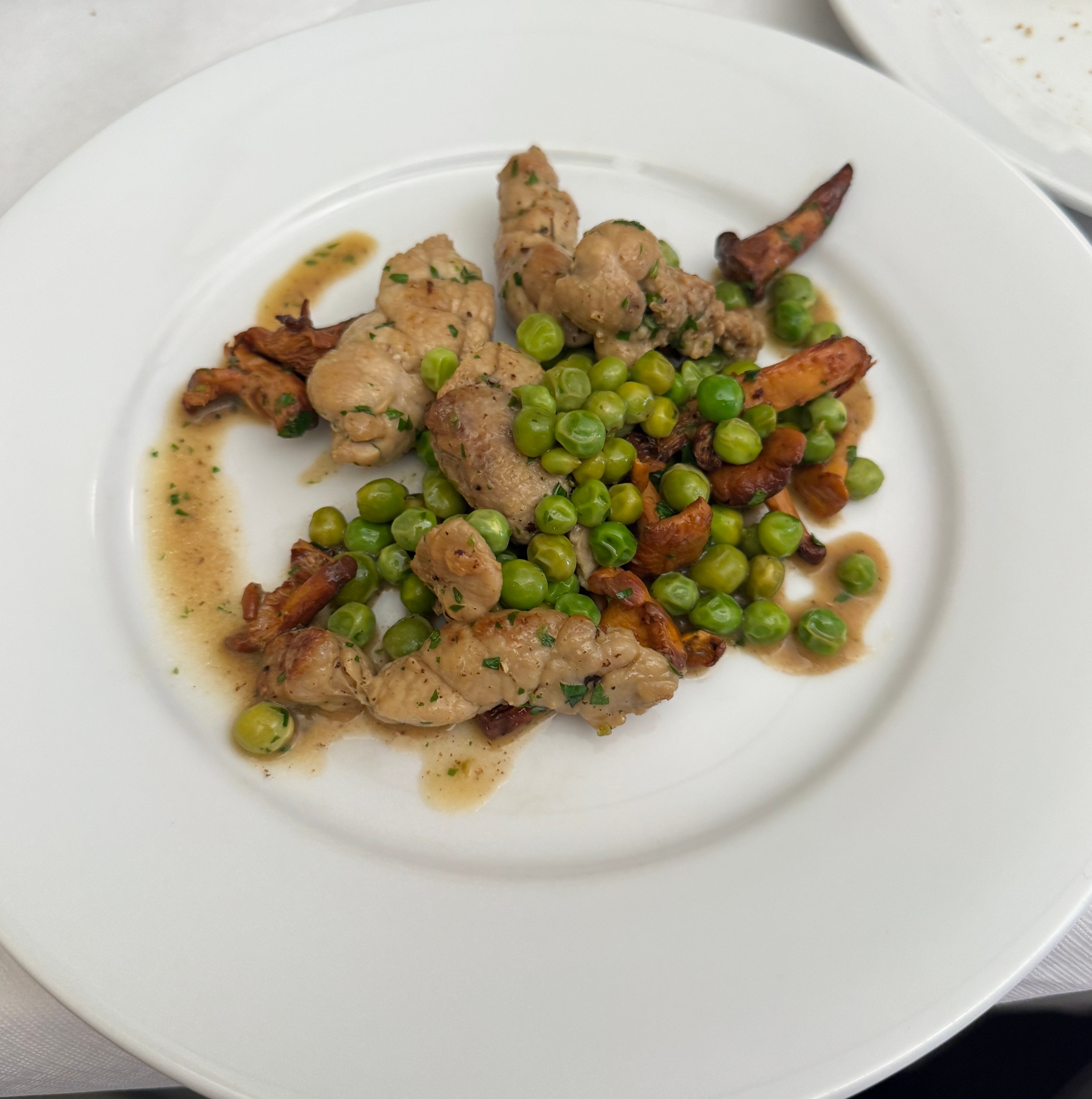
Next was a dish of lamb sweetbreads, girolles mushrooms, and English peas. This was the dish of the day. The sweetbreads were wonderfully cooked. The peas were sweet. The mushrooms were unctuous. And there was a delightful dose of butter sauce to bring it all together.
Pork came next. A simple roast, served with chilled ratatouille. Hearty, but also well-calibrated for a summer lunch.
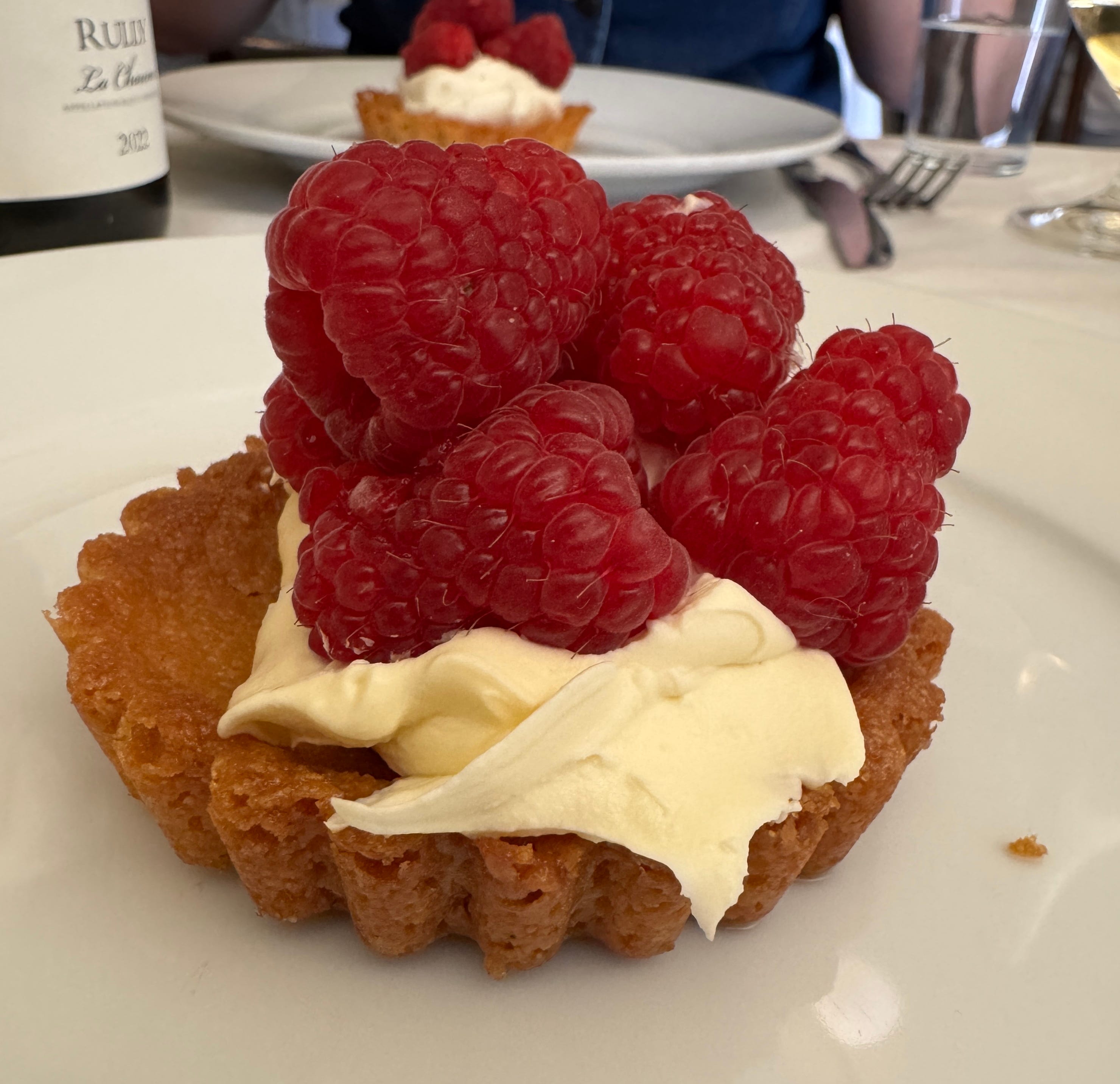
We skipped cheese, which I regret, but enjoyed a delicious tart for dessert.
Chef Hugh and one assistant prepared all of this for about 20 diners in an open kitchen without a proper hob or oven using only a couple of gas burners. That such a simple kitchen could produce such complex dishes was a testament to the Chef’s skill.
What’s more, the menu changes every day, based on available produce and the whims of the Chef.
As desserts were being prepared, Chef Hugh introduced one of the other guests — a well known Irish musician and flutist. He gave us a couple of gorgeous, moving tunes. Then his wife, a noted singer, stopped the whole room with a moving a cappella performance of her own. I’m ashamed to confess that I was so struck by the music that I entirely missed their names.
After lunch, I dwelled at the table to finish my coffee, and contemplated the experience. A great restaurant is meant to make you feel something — satiated at a minimum. Happy, if they are very good. Moved, if they manage to get food and experience in tune with one another.
Corcoran’s vision for the Yellow Bittern is to practice the kind of hospitality where anyone can feel welcome, and, on a good day, where anyone can be moved by the experience.
On the day that I visited, he and his small team were entirely successful. Two years into its journey, I believe the Yellow Bittern is precisely the restaurant that Corcoran set out to create. Few restaurateurs ever achieve that level of success. Doing so requires constant effort and attention to detail. Corcoran deserves considerable credit for both.
That Corcoran has opinions is mildly interesting but mostly immaterial. Jeremy King has opinions — about influencers, the right shape of hospitality, and much more. Chris D’Sylva has opinions, too. About who he won’t serve and the right sort of fish. Do any of those opinions make their restaurants less appealing? I think not.
So we conclude with our exam question: Is Yellow Bitten for professional lunch? I am happy to recommend it. For a very reasonable 50, you’ll get something delicious. And on the right day, you might discover something that really moves you.
Quick hit: Be ruled by heart rather than head, and you mind find something really moving.
Details: Booking essential. King’s Cross. ££.
Must call to book: 02033422162.
No website or Instagram.
Find it on Google Maps. 20 Caledonian Rd, N1 9DU.
Thanks for reading this week’s review. Tell me what you think in the Comments. And please subscribe if you haven’t already.
Many thanks Marshall for this generous and thoughtful review. It is greatly appreciated. I hope to see you again.
Great write-up, Marshall. One of your strongest ones.