

Weekly Review: Appalachia
Refined, innovative take on one of America’s best food regions.

Since I started this Substack a couple of years ago, I have never pretended to be an expert in food. I have always said that I am inexpert enthusiast, trying to help others find great places to eat and drink, and hoping to learn more along the way.
I regret to inform you that, on this subject, I am an expert. I apologise in advance if that winds up being a regrettable facet of this review.
Because there’s a new restaurant in London serving the food I grew up with.
Appalachia is a mountainous region of the U.S. that transcends state boundaries, rooted on the backbone of mountains — which long ago connected to similar ones in Scotland — that runs down the eastern coast.
This is easy to see in the map of Virginia — my home state — just below. The brown, orange, and purple bits are mountains. Appalachia.
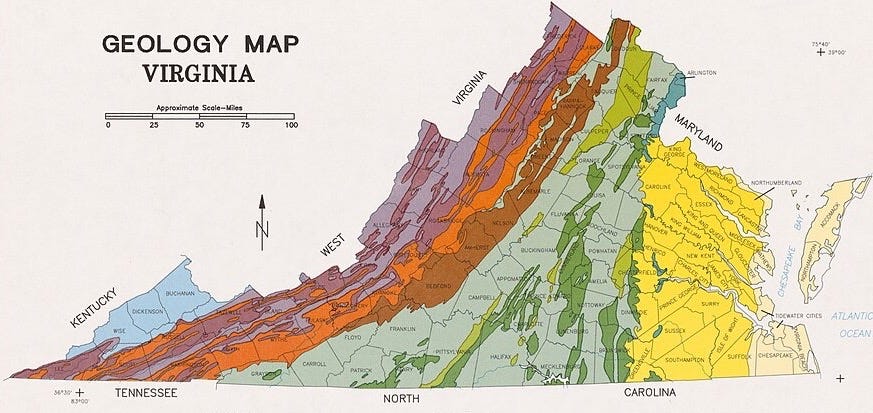
The yellow area is called the Tidewater — because the rivers are still tidal, right up to the point where yellow turns to green. As we get further south, the Tidewater is also called The Low Country.
In between, in the green, is the Piedmont.
As you might expect, the food of the Tidewater runs heavily to fish. The tidal rivers and bays of the southeastern coast are rich with sweet oysters, gorgeous fish, and the best crabs in the world. (Get lost, Cornwall.) The soil is fertile — so much so that it’s used for cash crops. Thus, meat is pork and chicken. No room for big livestock.
A similar story in the Piedmont. Historical land holdings tended to be large. Food was grown in kitchen gardens. There’s a lot of corn, beans, and tomatoes. The green bits on the map are also full of forests, so venison is a common treat.
As for Appalachia, the mountain country has always been a hard place to live, and a tough place to eat. Farms are small. There are a lot of preserves. Sausages. Smoked meat. And long cooks. Households have made the best they could, and over the years, their best has become damned good. A pot of water, beans and collard greens left on the stove to simmer all day yields a bowl full of nutrient-rich “pot likker,” which goes pretty well with corn bread.
This is simple, honest stuff.
And for decades, from the end of the Second World War until pretty recently, everyone hated it.
It was poor people food, and the let’s-eat-out middle class wasn’t interested.
This traditional cooking hung on in grandmothers’ kitchens, local diners, and a few “down home” restaurants with formica tables and worn out chairs.
Then, a few years ago, a chef called Sean Brock changed everything.
After growing up in Appalachia in Southwest Virginia, he moved to Charleston where he aimed to refine the region’s traditional cuisine.
He started with Low Country food, digging into records and obscure seed farms to restore a variety of rice that was common in South Carolina since forever until imported, mass produced rice killed demand. Carolina Gold rice is now the hottest thing in cooking. He also started using much-maligned ingredients like Ramps — greens like Collards or Chard that need long cooking and big effort to develop flavours.
Over the years, he started incorporating influences from Appalachia, and his cooking evolved.
Brock and his many protégés started the legendary Husk restaurant in Charleston, and slowly took over the south.
In 2015, Anthony Bourdain went to visit Brock and, after a long night of eating and drinking, they wound up — as so many have — at Waffle House at about 2:00 a.m. If you have no idea what Waffle House is or want to get a little window in the genius of Brock and Bourdain, take 5 minutes and watch this:
The School of Brock, with its many branches, has created the climate for others to flourish, too. And this unique regional cuisine is now so fashionable that you can enjoy it in a swish spot in uber-hip Shoreditch.
Appalachia opened just two weeks ago. It replaces Counter 71, a tasting menu place that had attracted considerable positive buzz.
The new chef is Ali Borer, who previously did stints at the Smoking Goat, Light Bar, and Nutbourne after training at Le Pont de la Tour and others. The concept started with co-owners Camilla Meshiea and Ryan Sheenan, who are both from the U.S. Sheenan is from Savannah, just a hot minute from Charleston, the heart of the gentile south and Brock’s Low Country revolution.
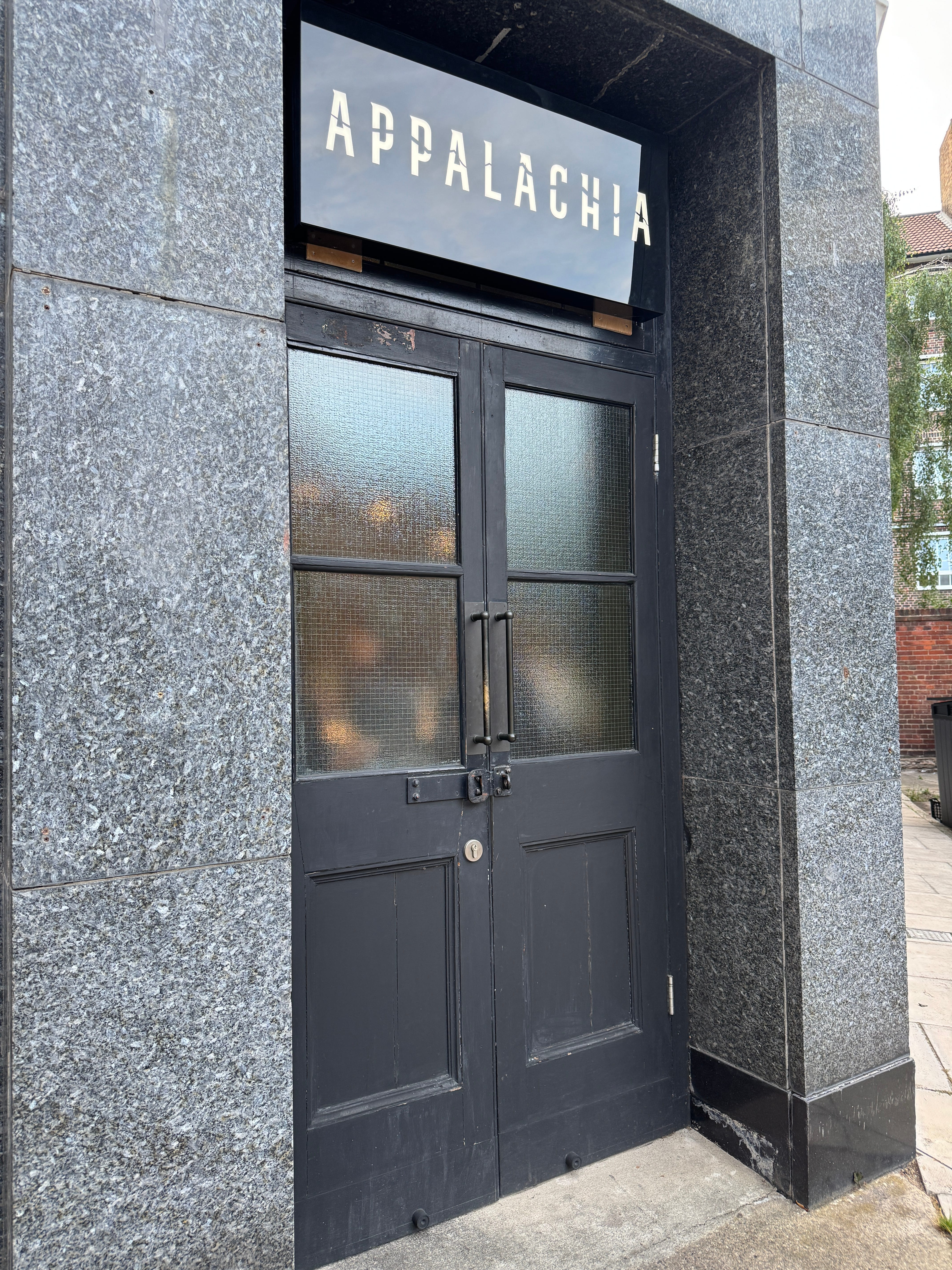
During our visit, Borer told me that he had never been to the region and developed the menu from research.
That’s hard to believe, because the food is both outstanding and sufficiently sensitive to the region’s traditions that it came across as innovative and refined but still respectful. That’s a tough line to tread, and Borer succeeds.
Appalachia has bowed to current trends — it is Shoreditch, after all — so everything is for sharing. There are snacks, nibbles, and big plates.
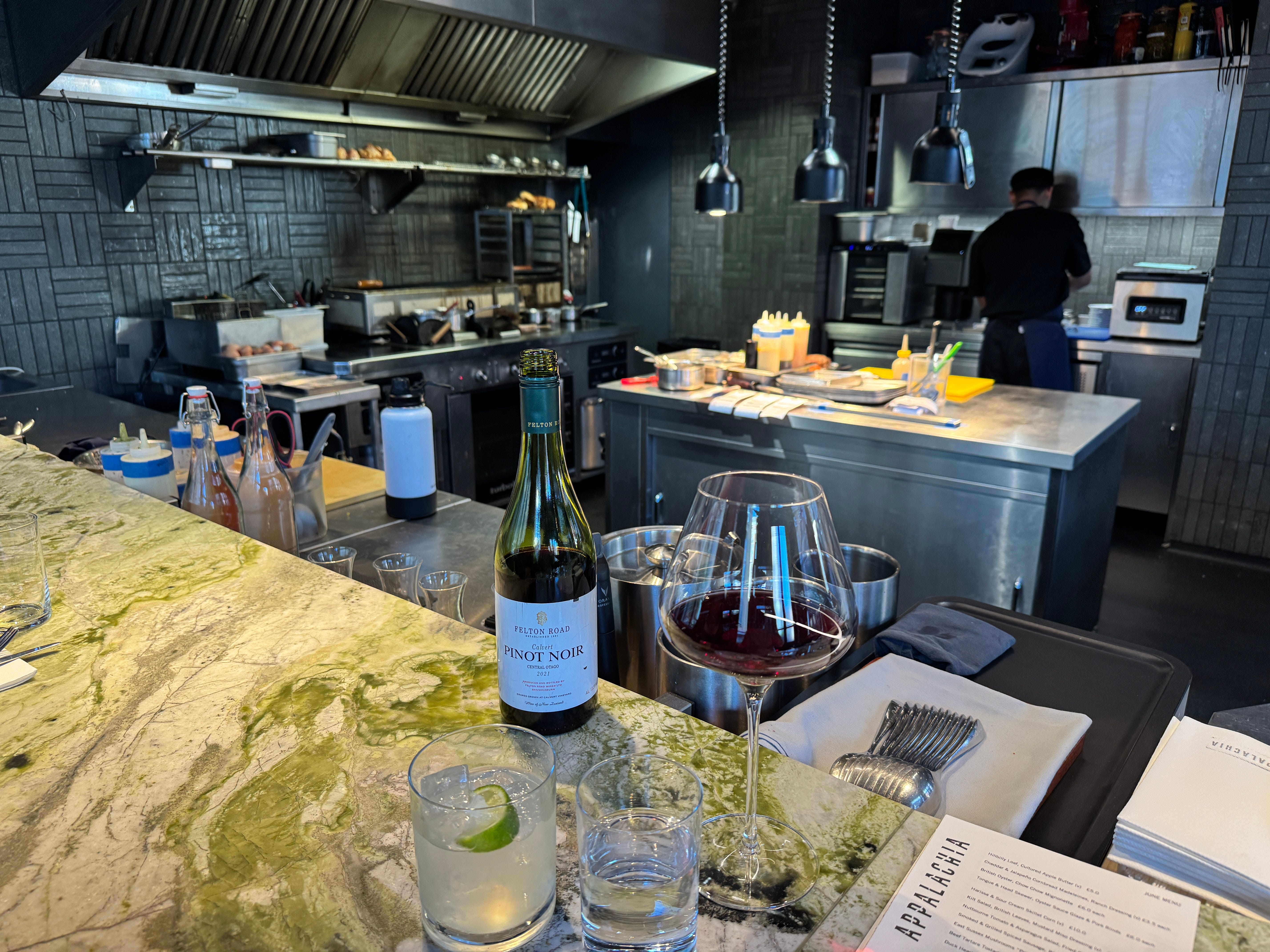
The 14-seat counter plays a central role, and adds to the homage. The vibe is convivial, and you could be sitting at the nicest diner or drug-store food counter in South Carolina. Borer and his team are fun to watch, and there’s a lot of interesting chatter between the team and diners.
Sommelier and General Manager Harry Cooper presides over the whole experience. The current wine list is still stocked with selections from the Counter 71 days and will undoubtedly evolve, but there are first rate choices. We enjoyed a lovely Pinot Noir from Felton Road in New Zealand. But the list does need more American options to support the regional theme. I’m sure that’s in the plans.
Cocktails come from the excellent Lowcountry bar, which has been a mainstay downstairs for a few years now. There are delicious, special concoctions updated each month, but my bog standard Old Fashioned was excellent, too.
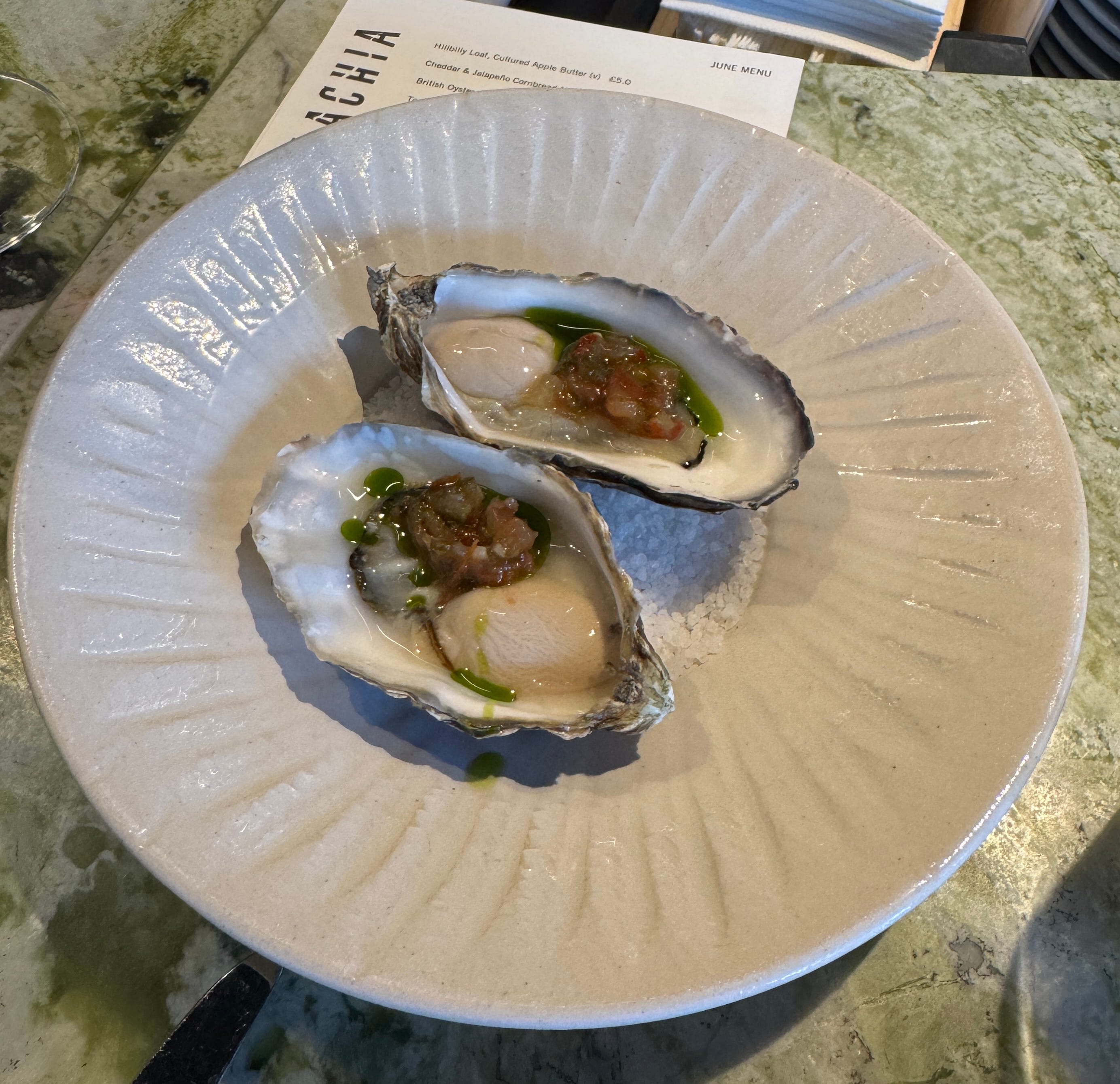
Our first snack was an oyster with “chow chow mignotte.” Chow chow is a traditional condiment benefitting from old-school preservation techniques. Tomatoes, onions, cabbage, peppers — whatever, really — are pickled and left to rest for days, weeks, or months. Borer’s version was subtle, and made the perfect balance for the sweet oyster.
Next was a “Tongue & Head Skewer.” Pork rinds were crumbled over the top, and a delightful oyster sauce added shine and depth. The skewer was made in tiny, thin layers, like a first-class kebab. The flavour was rich and intensely meaty. It was fantastic.
But the real test came next: Cornbread. Borer told me that he had been particularly focused on refining the recipe — trying to stay away from the dense, cake-like stuff that I grew up with. His version is more refined, flavoured with jalapeños and cheddar, it is a decadent stand-alone delight. Accompanying “ranch dressing” was also pleasant, but had too much dill for me. A compound butter would probably be better choice.
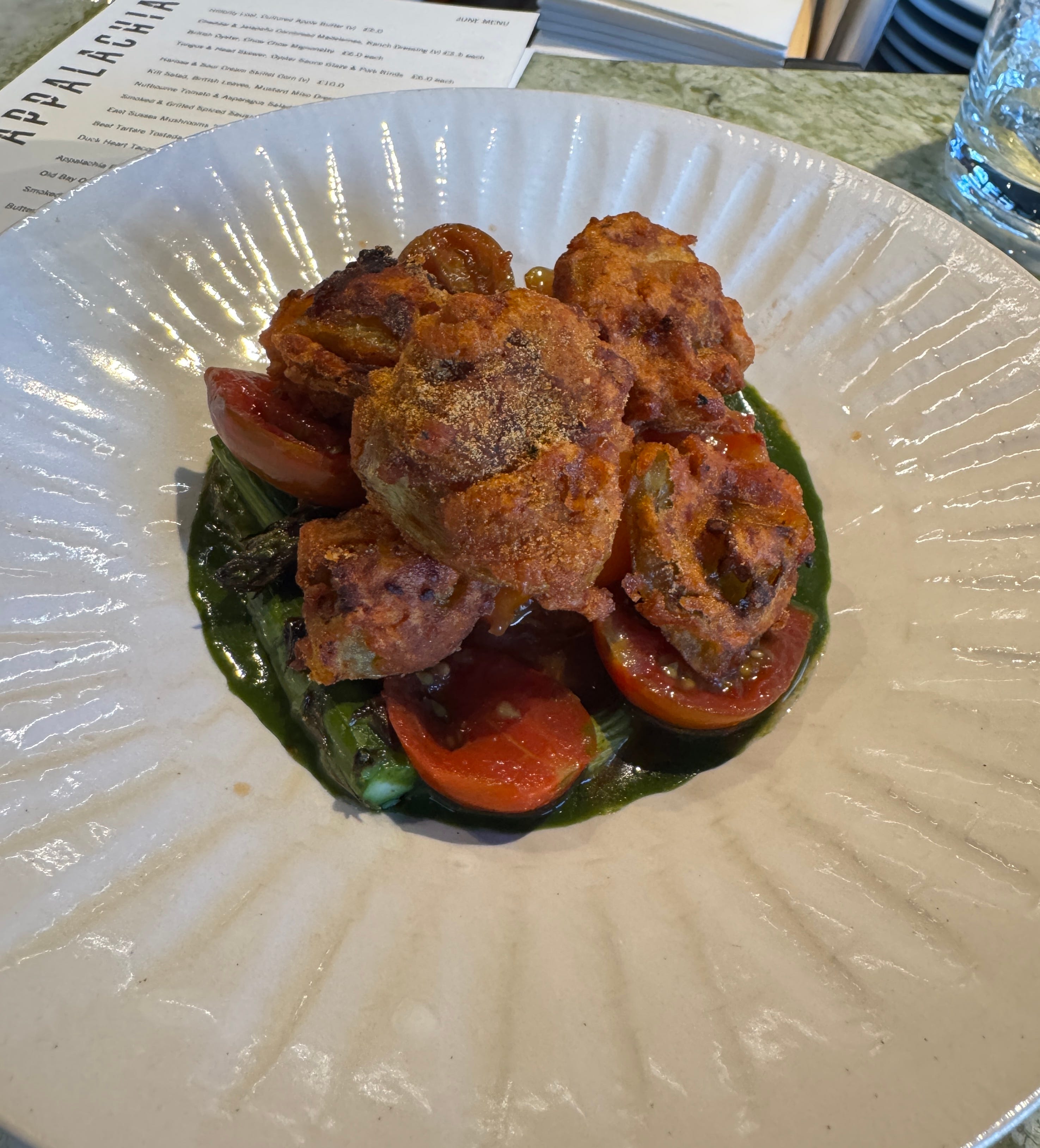
Tomato and asparagus salad was served with fried green tomatoes and a deep, green sauce. This was another risk from Borer. Fried green tomatoes are so iconic that they have their own award-winning movie. And finding underripe tomatoes that actually taste good when battered and fried requires considerable courage. Happily, this was was one of the best dishes of the night. The asparagus added crunch. Blanched and skinned tomatoes added big bright flavour. The fried, green ones brought sourness and were served warm, adding stimulus for the palate. And the green sauce brought a bit of spice. I finished the remnants with a spoon.
Mushrooms with “Potlikker” and a crispy duck egg were slightly less successful. I’m not sure what the potlikker descriptor referred to. I was expecting some sort of broth, but none was apparent. The centrepiece of the dish were king trumpet mushrooms, which I found too fibrous. An assortment of other mushrooms were really tasty. But the duck egg was a bit overcooked — ours ran to hard boiled — so we didn't get the benefit of the runny yolk.
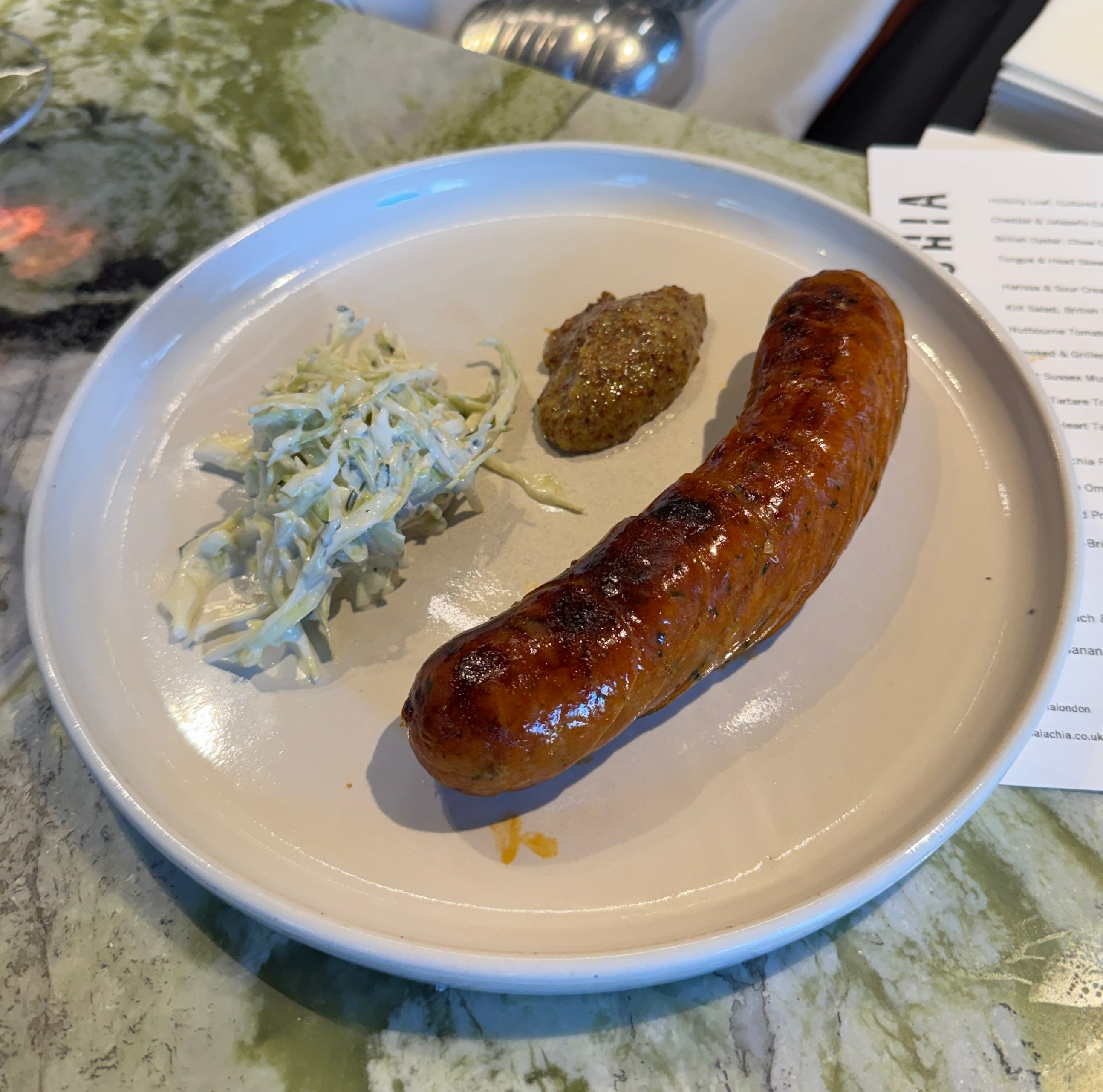
The next dish restored momentum. Spiced pork sausage — made entirely in house — was smoked then grilled and served with blue cheese slaw and Bourbon mustard. It was served simply, but the sausage itself was a gift from the gods. Incredibly flavourful, it sang to my soul. Accompanying slaw and mustard both enhanced the experience still more. The was authenticity and refinement all wrapped-up to produce perfection.
Our final savoury was “Old Bay Omelette” with crab and a seaweed “butter sauce.” This was millimetres from greatness. Old Bay is a distinct, local spice blend that we use in boiling crabs, shrimp, and other seafood. Sadly, its flavour didn't;t quite come through. But the crab was fantastic, the omelette beautifully cooked, and the butter sauce a delight. I ordered more cornbread so that I could sop it up.
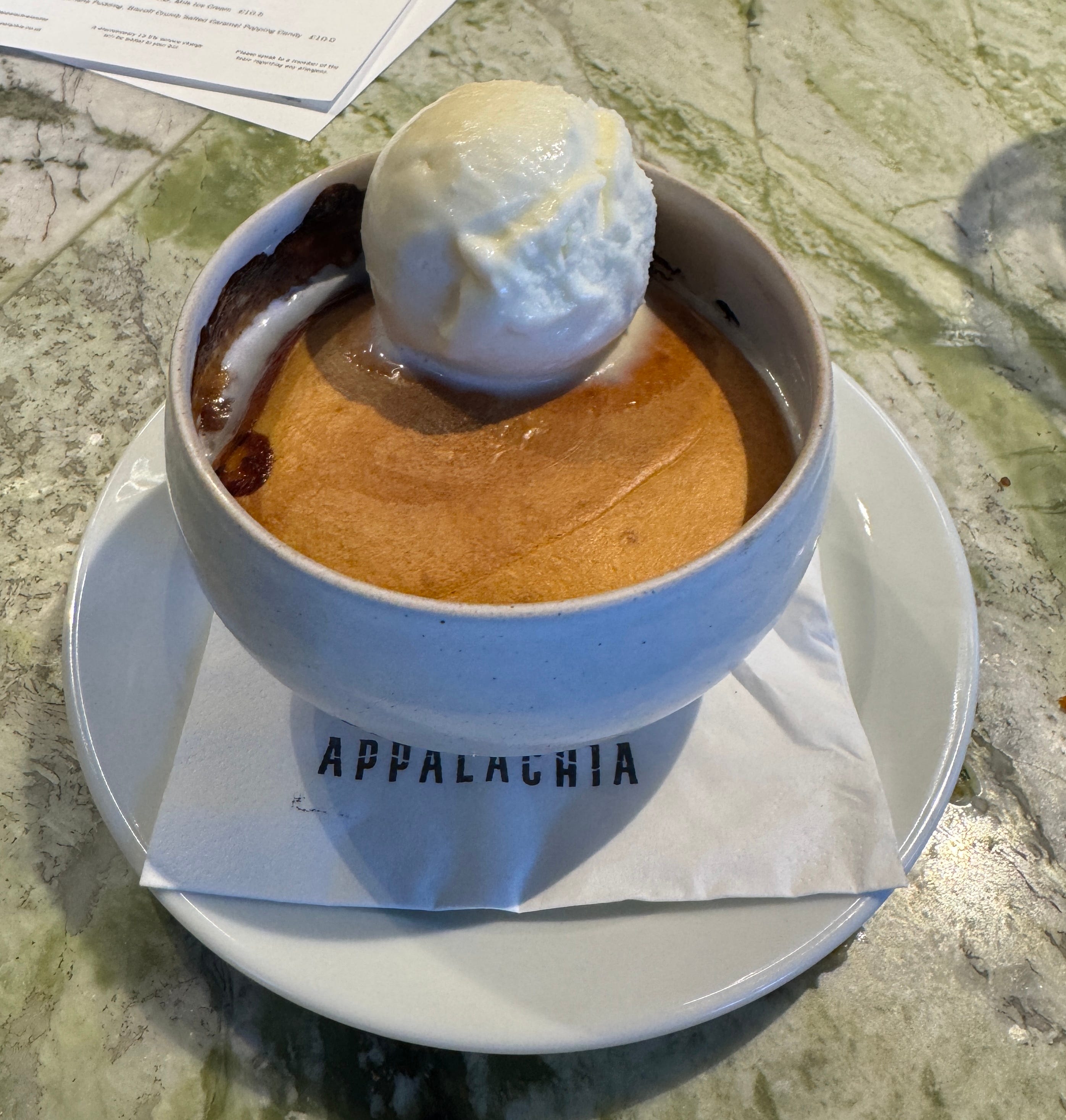
For dessert, I coveted the peach and rhubarb cobbler. Unfortunately, this was another experiment that didn't quite work. The cobbler topping was too caky and solid. It should allow for the fruit to peak through. Given the rhythm of the restaurant, I think the dessert offering would be on much firmer footing if it focused on traditional sweet pies from the region — apple, lemon chess, chocolate chess, sweet potato. These could be made ahead of time and warmed up quickly, and they would be outstanding if refined by someone of Borer’s calibre.
But just before we had moved to dessert, I asked Borer if I could try his pimento cheese. It’s on the menu as a topping for a burger. Pimento cheese is the ultimate level-set for kitchens doing southern food. There a thousand opinions on the best recipe. Everyone has their own take, and it is easy to get wrong. Borer’s was great. Better than the one I grew up with. Better the one that I make in my own kitchen.
That gives me tremendous confidence that, as Borer and his team keep getting to know the food and traditions of the region, Appalachia will continue to succeed in its efforts to serve refined, intriguing versions. Indeed, I’m confident that Sean Brock would welcome Borer’s efforts and appreciate the desire to bring Appalachia and the food of the Low Country to Shoreditch.
My quibbles notwithstanding, I am definitely going back to Appalachia — and soon. I want to try the smoked pork chop with spicy collards. I’m also eager for the chicken with miso grits and black beans pepper gravy. The duck heart tacos looked amazing, too.
Sadly, Appalachia is not currently open for professional lunch. But as a place for professional dinner, it’s a fantastic choice. The experience is really fun. It’s an energetic, uplifting experience. And the food is genuinely great.
Moreover, the timing couldn’t be better. As many of us stay up late to watch the World Cup in the U.S., we can enjoy the best food that Appalachia has to offer, without needing a plane ticket.
Dominic Preston recently reflected on an intriguing point of food fashion: American food is hot in the UK, at the moment. And British food is hot in the U.S. He’s right. So in addition to being excellent, Appalachia is on trend. I’d suggest you head there to try it now. Beat the crowds. Love the sausage. You’ll thank yourself.
Quick hit: Refined, innovative take on one of America’s best food regions.
Details: Booking essential. Shoreditch. £££.
Visit their website. More on Instagram.
Find it on Google Maps. 71 Nile St, N1 7RD.
Thanks for reading this week’s review. Tell me what you think in the Comments. And please subscribe if you haven’t already.
These are my favourite reviews of yours (like the 'different kinds of BBQ' one a while back). I really like your enthusiastic explanations of how American food evolved, and why. No need to apologise, therefore, for these occasional forays into genuine expertise. :)
Were you in London when Brad MacDonald was cooking at The Lockhart and Shotgun? His cornbread was legendary.